Saturday, September 27, 2025

AUBUT: Trust betrayed, duty denied

 https://www.westernstandard.news/opinion/aubut-trust-betrayed-duty-denied/67844

When law becomes plunder: How Canada’s rulers exempt themselves from the standards they impose.

A Canadian flag 

Published on: 


At the heart of any free society is a fragile compact: those entrusted with authority must exercise it with duty to the people they serve. Without trust, duty becomes hollow. Without duty, law degenerates into coercion. Civilization depends on the alignment of law, ethics, and morality. When politicians exempt themselves from that alignment, citizens are left with rules that punish the weak while shielding the powerful. That is not justice. It is betrayal.

Canada today suffers from exactly that betrayal. Politicians at every level — municipal, provincial, and federal — appear accountable but in practice live with impunity. Citizens are bound by codes of conduct, contracts, and professional standards that demand honesty, diligence, and fairness under penalty of losing careers and reputations. Professionals like doctors, engineers, and geoscientists face suspension or loss of licence if they act dishonourably. Politicians, whose decisions affect millions, face almost no such risk. Their “codes of conduct” are little more than window dressing, enforced by commissioners who answer to the same councils or legislatures they are supposed to police.

This double standard leaves politicians insulated from consequences that would end the career of any ordinary professional. Cabinet ministers preside over billions of dollars disappearing without explanation. Mayors and councillors hold in-camera meetings to appoint their allies. Integrity commissioners submit reports to the very bodies they are supposed to scrutinize. In every case, accountability is treated as optional.

I experienced this firsthand in Nipigon, where the council imposed a Municipal Accommodation Tax that conscripts small businesses into unpaid government service. By-law 1940 forces accommodation providers to calculate, collect, remit, and account for a tax under threat of penalty, with no compensation. When I challenged this in court, I argued that to compel labour without fair pay is no different in principle than indentured servitude. The judge dismissed that claim because the Municipal Act was silent on compensation. But silence cuts both ways: nothing in the law prohibited fair compensation either. The court preferred to interpret absence as denial. In so doing, it sanctioned coercion not on the basis of justice, but on the basis of omission.

This is where law without ethics becomes indistinguishable from tyranny. Frédéric Bastiat warned of “legal plunder,” when the law is twisted into an instrument of theft rather than protection. Friedrich Hayek warned in The Road to Serfdom that once government uses law to direct labour and resources without consent, freedom begins to erode. Both men understood that when law departs from morality, freedom collapses. That is the path Canada is on.

The injustice is magnified by the imbalance of risk. As a professional geoscientist, I lived under a code of conduct that held me personally accountable for honesty and integrity. A breach could cost me my licence and livelihood. The same is true for doctors, lawyers, engineers, and countless other professions. Citizens live with real penalties for real misconduct. 

Politicians, however, are insulated. Cabinet ministers preside over billions of dollars vanishing. Parliament is prorogued to avoid scrutiny. Mayors and councillors make appointments behind closed doors. Conflict of Interest Acts are so narrow that they institutionalize conflicts instead of preventing them. Integrity commissioners submit reports to the very councils they are supposed to police. There is no independent enforcement, no binding penalty, no real accountability.

This is not merely a technical flaw. It is a moral one. Trust is not optional in public service. It is the bedrock upon which authority must stand. When politicians violate that trust, when they refuse to uphold their duty to the people, they attack the very legitimacy of law. Citizens see one set of rules for themselves and another for those in power. That is how respect for institutions dies. And without respect, compliance becomes fear-based rather than voluntary. The law ceases to be law and becomes only rule by force.

Critics sometimes respond that “we all pay taxes,” as though the burden of taxation justifies any burden imposed by government. But that misses the point. Paying taxes is not the same as being conscripted into unpaid service. There is a profound moral difference between parting with money and surrendering labour. One is a transaction while the other is servitude. That distinction was invisible to the court in my case, which lumped my claim into the same category as objecting to income tax. But it is precisely that blindness — treating fairness as irrelevant — that demonstrates how far law has drifted from its ethical foundation.

The problem extends beyond taxation. Across the country, we see law weaponized as a tool of political punishment. Consider the ongoing prosecution of Tamara Lich and Chris Barber, leaders of the 2022 Ottawa protests. Charged with mischief, their trial has dragged on for more than a year, reportedly the longest in Canadian history for such an offence. Even before a verdict, they have endured the punishment of process: restrictions, stress, and endless expense. The Ontario government pours taxpayer money into prosecuting them, while citizens watch the spectacle of state power deployed against dissenters. This is lawfare: punishment by procedure. The message is clear — resist, and the state will grind you down.

When combined with the lack of accountability for politicians themselves, the picture is grim. Lawfare punishes the weak, while immunity shields the strong. Together, they create a two-tiered system where justice is no longer blind but rigged. It is not conspiracy. It is systemic design. Politicians have built rules that protect themselves and punish others, all while cloaking the imbalance in the language of law.

Why do people accept this? Fear, resignation, and habit. Most citizens comply because penalties are harsh, and resistance feels futile. Judges defer to statutes rather than principles. Media outlets, many subsidized by the governments they are supposed to scrutinize, distract the public with trivialities while burying scandals. A culture of resignation takes hold: unfairness becomes normal, and dissenters are dismissed as cranks. Yet history shows that civilizations cannot survive when law is stripped of morality. Rome fell when corruption rotted its institutions. Democracies collapse when citizens lose faith that the law serves them. Canada is not immune.

The remedy is not more laws. We already have enough statutes, codes, and regulations to drown in. The remedy is a restoration of trust and duty. Politicians must be held to at least the same ethical standards as professionals. If a geoscientist can lose his licence for dishonesty, why should a minister keep her office after losing billions of public dollars? If a doctor can be barred from practice for misconduct, why should a mayor remain in office after violating fiduciary duty? The imbalance must end. Trust without accountability is not trust at all. It is fraud. Duty without consequence is not duty. It is theatre.

The law must be more than a mask for power. It must embody justice, fairness, and morality. Bastiat, Hayek, and others warned what happens when law becomes detached from ethics: liberty dies, and coercion fills the void. My case in Nipigon may be small in scale, but it is a symptom of a much larger disease. When small businesses are conscripted into unpaid service, when citizens are punished for resisting, and when politicians live above the rules they impose, the law ceases to protect. It becomes plunder.

Civilizations live or die on the strength of their laws. But laws must be rooted in trust and duty, not just power. If Canada continues down the path of legal plunder and political impunity, if our leaders continue to betray trust and deny duty, the outcome is certain. The people will cease to respect the law, and the law will cease to deserve respect. That is the road to serfdom. That is the betrayal we face.

So, what can we do? We cannot turn away when others fight for fairness. Each of us must begin by living with honour ourselves. If we are not willing to hold ourselves accountable, how can we expect to elect honourable people? I believe in doing the right thing, fearlessly. When Americans like Abraham Lincoln, John F. Kennedy, Martin Luther King Jr., and, most recently, Charlie Kirk, spoke out against injustice and sought peaceful conversation, they were murdered for their courage. 

Their sacrifice should remind us that doing the right thing carries risk, but doing nothing is also a risk to our identity. 

Canada used to mean courage, honesty, and fairness. We need to reclaim that. Speak up. Look for candidates who believe in honour and duty, not self-interest, and only vote for them. Join in community action. Talk to neighbours, and even to strangers. 

If we allow injustice to become routine, we will lose more than laws. We will lose what it means to be Canadian.


Sunday, September 14, 2025

AUBUT: When law becomes plunder

 https://www.westernstandard.news/opinion/aubut-when-law-becomes-plunder/67477

How municipal accommodation taxes turn business owners into unpaid servants.

Dock 

Published on: 

I run an accommodation business in Nipigon, Ontario. Like most small business owners, I and my meagre staff sweep the floors, change the lightbulbs, reconcile the books, and greet guests after long days because that is what it takes to keep the doors open. What I never signed up for, and never consented to, was becoming an unpaid tax collector for the Township. Yet they enacted a bylaw that demands I, and my staff, do so. Every motel and short-term rental must now calculate, collect, hold, and remit a Municipal Accommodation Tax (MAT) while absorbing all administrative costs. The penalty for refusing is fines and interest. There is no opt-out, and most importantly, there is no compensation.

I went to court to challenge this. I argued a principle that should be self-evident: in a free society, nobody should be compelled to perform labour for the state without fair compensation. Judges, clerks, lawyers, and municipal staff are all paid for their work. A specific case in point, and one I described to the judge, is that of Property Tax. The Municipal Property Assessment Corporation, an Ontario Crown Corporation, decides what a home or business is assessed at. They all get paid. The municipality has its employees prepare the tax invoices and manage the collection of those taxes. They all get paid. 

Why should small business owners, forced into government service, be the only ones expected to work for free? The judge’s answer was devastatingly narrow. Because the law does not explicitly require municipalities to compensate providers, the court would not create that right. Case dismissed.

Some will shrug and say it is just a small tax, but administration is work. Anyone who runs a business knows that new compliance duties eat up hours and dollars, hours that cannot be spent serving customers, and dollars that cannot be spent hiring staff, maintaining rooms, or lowering rates to be competitive. In larger chains, head office absorbs the pain. In small towns, it is the owner and a handful of employees doing double duty. We are told this is a “civic obligation,” as if it were the same as jury duty: brief, rare, and state-managed. It is not. This is continuous, transaction by transaction, and entirely outsourced to private hands. International standards define forced labour as work exacted under menace of penalty and not offered voluntarily. That is the plain reality here. Refuse, and you are penalized. There is no voluntariness, and there is no compensation. 

There is only the command and the cost.

If this policy had been hammered out with public input and industry consultation, the outcome might have looked different. It wasn’t. The by-law was shepherded by a council built on appointments, not elections, with key steps handled in-camera, behind closed doors. 

Accommodation providers were given an “information session,” but no meaningful plan for how MAT would actually deliver more visitors. Every local provider signed a petition opposing implementation under these terms. It was ignored. When I raised this democratic deficit in court, I was told I lacked evidence. Of course I did, because the very processes that would supply it were conducted in secret. That is a closed loop: hide the records and then dismiss critics for not having them. If you wonder why cynicism takes root, start there.

The Ontario Superior Court’s reasoning turned on legislative silence. The Municipal Act authorizes the tax and the regime; it does not speak about compensating those compelled to administer it. From the bench, that silence meant no right to compensation. This is the flaw that should alarm every small business in Canada. If the legislature fails to protect you, the courts will not. They will not weigh fairness. They will not consider the obvious analogy that municipal staff who collect property taxes are paid while private businesses are not. They will not recognize that compelled work is still work, even when cloaked in the rhetoric of civic duty. The message is stark that unless the law hand-writes your dignity into the margins, you do not have it.

More than a century and a half ago, Frédéric Bastiat wrote The Law. He warned that when government uses the force of law to take from some and transfer to others, it becomes legal plunder. Nipigon’s MAT regime is a textbook example. The Township found a revenue stream and the cheapest way to collect it: outsource the labour to small businesses and pay them nothing. Staff who process property taxes get a wage and benefits while we get orders and penalties. That is cost-shifting by statute, not partnership, and it corrodes the very idea that law should protect the equal dignity of persons.

Supporters will argue that government can require duties of citizens. True. But the classic examples such as jury duty and limited emergency service are bounded, public, and supervised by the state. Collecting a continuous municipal tax on every booking, month after month, is qualitatively different. It is an ongoing administrative function of the municipality, executed at the private expense of businesses that never wanted it, never volunteered, yet cannot refuse. The fact that the duty is imposed by by-law does not transform the nature of the work. Renaming a mandatory charge a ‘donation’ doesn’t make it voluntary or charitable.

One reason we are here is Canada’s constitutional blind spot around economic liberty. The Charter protects life, liberty, security of the person, and equality, but courts have consistently refused to treat the right to earn a living or the right to fair compensation for compelled labour as core Charter interests. Even our “security of person”, at least so far, when it came to the Covid response, has similarly been denied us. That may be doctrinally tidy, but it is practically incoherent. 

A society that says work equals dignity then turns around and declares the dignity of small business owners purely discretionary, contingent on whether the legislature remembered to write it down. I am not saying the Charter guarantees a wage for every civic duty. I am saying that when government outsources a continuing administrative function to private citizens, with penalties for refusal, courts should scrutinize that arrangement as something more than a benign civic obligation. There is a line between the common good and conscription. MAT crosses it.

We were told MAT would mean more heads in beds. That is a good slogan but it is not a plan. Local operators asked for concrete detail: what programs, what marketing, what targets, what accountability? Instead, we got a collection system first, and a vision later — maybe. 

The nearby community of Terrace Bay enacted a MAT for their accommodation providers in 2020. At the “information session” in 2023, a representative was there to provide supportive evidence for their program. Three years after implementation, the representative admitted that while money was collected, not one concrete activity had been launched to increase stays. Yet the independent “tourism entity” got 50% of the money raised and spent it on nothing concrete other than paying the salaries of its employees. The uncomfortable truth is that MAT revenue can become just another pot of money with diffuse accountability, especially when oversight is entangled with local relationships and appointments. If you want a partnership with business, you start with transparency and consent, not secrecy and compulsion.

Some will dismiss this as a tiny-town squabble. They shouldn’t. The logic that carried the day in court — that if the statute is silent, your labour is free — scales to any jurisdiction that wants to shift administrative costs off the public ledger and onto private backs. And a lot of municipalities have jumped on the bandwagon, not because they believe it will work but because it is another source of revenue where the legislation makes sure even unwilling victims of the proposed help receive little to none. Today it is MAT. Tomorrow it is another fee, reporting regime, or levy collected by “designated providers” under penalty. If you run a restaurant, a shop, a bed-and-breakfast, ask yourself how many hours you can surrender before your business model collapses. Then ask why the government gets those hours for free.

There is a simple, principled fix. If municipalities want private businesses to administer a tax, they should either pay for the work through a clear, published administration fee, or permit providers to deduct a reasonable percentage to cover their costs. Pair that with genuine consultation, public oversight of spending, and performance targets tied to tourism outcomes. If MAT truly drives value, prove it — and compensate the people doing the paperwork.

I have joined a national small-business advocacy group to push for provincial reform. I will keep pressing for transparency and fair dealing in my community. I will keep saying, without apology, that compelled unpaid labour is wrong, whether you dress it up as partnership or hide it inside a by-law. And I am asking readers — business owners, employees, and citizens — to demand the same from your councils and your MPPs. Freedom is not only the absence of chains. It is the right to control your labour, to say yes or no, and to be fairly compensated when the answer is yes. When law forgets that, it stops being protection and becomes plunder. Nipigon has reminded us how quickly that can happen. The remedy will not come from the courthouse. It will come from people who refuse to mistake compulsion for duty and who insist that government, at every level, treat their time with the same respect it grants its own.

Alan Aubut is a retired geologist, based in Nipigon.


Saturday, August 23, 2025

AUBUT: From apathy to agency, rebuilding Canada’s democracy

https://www.westernstandard.news/opinion/aubut-from-apathy-to-agency-rebuilding-canadas-democracy/66959 

Practical, peaceful reforms to restore legitimacy, empower citizens, and turn voting into a tool for real change

Voting 

Published on: 

Canada's political system, like many others in the West, is showing signs of institutional fatigue and public disengagement. Yet for those still committed to the nation and its potential, the question is not whether to resist or retreat, but how to build, how to create functional, forward-looking systems rooted in civic responsibility and institutional renewal. 

As previously discussed in the article Canada's One-Way Political Conversation Has To Be Challenged, our country is trapped in a state of entropy, drifting between preservation and destruction with no meaningful building underway. We seek a future in which citizens are empowered, heard, and respected, not managed or pacified. Building requires structure, not slogans. It demands functional democratic tools that restore legitimacy and create real pathways for reform. 

Our goal is not to burn the system down, but to reintroduce vitality where apathy and cynicism have taken hold. This piece examines what practical, peaceful methods can succeed within Canada's existing system to restore meaningful democratic participation and give every citizen a voice worth using.

Canada's political system, like many others in the West, is facing a legitimacy crisis. Turnout remains low, especially among younger voters, and public trust in government institutions is eroding. Scandals, cronyism, and top-down governance have led many Canadians to conclude that their vote no longer matters. 

The sense of shared nationhood is fraying, and with it the belief that government still acts in the common interest. It is tempting, in the face of such dysfunction, to call for radical solutions. But history and principle both warn us that violence or coercive force, even when cloaked in moral urgency, corrupts what it seeks to save. The only sustainable path forward is one that builds, not destroys.

To build within a system suffering institutional decay requires identifying what levers of influence still remain and using them precisely. Canada’s existing electoral and legal frameworks are not beyond salvage. Rather, they are underused and misapplied. The voting system is treated by many as a futile exercise between the lesser of evils. But if restructured correctly, the act of voting can become the most potent tool of democratic reform available.

The first step is to confront voter apathy, not by blaming voters, but by acknowledging the structural failures that drive it. People don’t vote because they don’t see how it changes anything. When mainstream parties drift toward managerial sameness, the ballot becomes a ritual of consent rather than a real choice. 

Yet what is rarely measured is why people abstain. Polls only ask questions pre-approved by those conducting them, and their samples are too small and clustered to capture broad sentiment. That is why election results, imperfect though they are, remain the most trustworthy form of public data. Everyone has equal access. The sample size is sufficient. The results are binding.

To better capture public discontent, a simple, low-resistance reform would be to include a permanent ballot option, “None of the Above” (NOTA). This could be introduced through a straightforward amendment to the Canada Elections Act, requiring the Chief Electoral Officer to include a NOTA line on every federal ballot. While no such amendment has yet been formally proposed, its simplicity makes it an ideal starting point for citizen-driven legislative advocacy. The purpose is not symbolic protest, but formal accountability. 

NOTA reveals how many voters reject the offered slate entirely. It is not about encouraging disengagement, but about giving voice to the already disengaged. It makes invisible frustration measurable. And unlike spoiled ballots, it cannot be dismissed as an accident or confusion. Australia, which mandates voting and reports over 90% turnout, shows that participation can be enforced gently, through small fines or civic expectation. Adding NOTA to the Canadian ballot would provide the means for expressing legitimate discontent without discarding the democratic process.

Yet NOTA is just one piece. We must also improve our understanding of why voters are dissatisfied. One method is to conduct a scientifically sound, post-election civic poll. This would not be a media poll or a partisan survey. It would be a legally grounded exercise, much like the census, administered by a partnership between Elections Canada and Statistics Canada. 

The key features of this post-election audit would include a sample drawn from the national electors list, ensuring full coverage and legal standing. A stratified random sampling, with built-in declustering methods to eliminate geographic bias. A sample size of at least 100,000, enabling high-confidence national and regional analysis, with mandatory participation for those selected, enforced under the same principles as the census.

The questions would be few, public, and transparent. Focused on civic attitudes, not policy preferences. For example: Do you feel your vote had influence? Would you support mandatory voting? Do you believe the current system represents your interests? The results would be anonymized, published in full, and available for public scrutiny and academic analysis. This would not replace elections, but instead would contextualise them. The goal is to rebuild legitimacy through honest feedback, not manufactured consent.

Beyond polling, the core political structure itself must be opened to reform from the outside in. The mainstream parties are structurally resistant to meaningful change. Their internal systems of party discipline, whip control, and patronage make dissent nearly impossible. To break this cycle, Canadians must shift focus away from party platforms and toward structural mandates. Instead of electing ideologues or careerists, we elect individuals with one purpose, to repair the democratic framework.

This could take the form of a national federation of independent civic candidates. Each would run on a common charter, committing to basic reforms such as NOTA, electoral system redesign, campaign finance transparency, and citizen recall provisions. 

Comparable blocs have emerged in other democracies, for example, anti-corruption independents in Eastern Europe, proving the viability of loosely coordinated reformist coalitions. They would not form a party but a bloc bound by principles rather than hierarchy. Their message is not "vote for us," but "vote to fix the system." 

This stands in sharp contrast to efforts like the Rhinoceros Party or the Longest Ballot Committee, whose actions, whether satirical or performative, trivialize the very system they claim to challenge. Success would not require majority control. A dozen such MPs, elected in targeted ridings with high disillusionment, could force parliamentary debate and block undemocratic legislation. Even one well-placed MP can file bills, initiate committee inquiries, and elevate public awareness.

Strategically, this requires a digital platform, ideally open-source and transparent, to coordinate volunteers, funding, and training while decentralizing action. Civic tech tools such as NationBuilder, Loomio, or custom-built portals can provide the backbone for such campaigns. 

It mirrors how civic movements succeed globally with centralized infrastructure and local execution. Campaigns would focus on small ridings where turnout is low and loyalty weak. The target is not the most ideological but the most neglected, places where hope has eroded but not vanished. These become the proving grounds for democratic renewal.

To further support this movement, proposed legislation must be pre-drafted as simple, transparent, and legally sound. Canadians need to see that the path is not only necessary but doable. Bills should be ready to table on NOTA, post-election polling, mandatory voting, and electoral transparency. These should be made publicly available in draft form for citizen review prior to introduction, reinforcing transparency and trust. Their simplicity is their strength. The more modest and clear the proposal, the harder it is for opponents to reject it without revealing vested interests.

Crucially, all of this avoids violent confrontation, radical upheaval, or fringe ideological capture. It restores faith by building, not destroying, the civic architecture Canadians were promised but have yet to receive. It speaks to voters not as customers of political parties, but as owners of a system in disrepair.

Canada’s system does not need to be burned down. It needs to be rebalanced. That means bringing the builder back into the national conversation. For too long, we have been governed by preservers, those who manage, regulate, and delay, and destroyers, who dismantle under the guise of reform. The builder, who imagines and constructs, has been marginalised. The builder is the citizen who proposes, innovates, and advances not through protest or complaint, but through lawful contribution and principled disruption. 

We must correct this imbalance, not with slogans but with structure. A local legislative reform, public accountability tools, and citizen-driven ballot access initiatives that re-empower the electorate. Only then can democracy move from performance to purpose.

This path will not be easy. It demands civic patience, organizational effort, and strategic thinking. But it is the only path available that does not demand surrender to cynicism, violence, or authoritarianism. It is the path of citizens, not subjects. It begins with the simplest of acts, which are to vote, to speak, and to refuse to be ignored.

Alan Aubut is a retired geologist, based in Nipigon.


Friday, August 1, 2025

AUBUT: Canada's one-way political conversation has to be challenged

https://www.westernstandard.news/opinion/aubut-canadas-one-way-political-conversation-has-to-be-challenged/66572 

'Once a metaphor for shifting public opinion, the Overton Window has been replaced by a mechanism of exclusion — where media, government, and cultural elites now decide which ideas may enter and which must remain forbidden.' 

AUBUT: Canada's one-way political conversation has to be challenged 

Published on: 

 The Overton Window is a political theory that describes the narrow band of ideas considered acceptable in public discourse at any given time. Originally developed by Joseph P. Overton of the Mackinac Center for Public Policy, it was designed as an analytical tool to explain why some policies gain traction while others are dismissed, regardless of their logical or moral grounding. It became a framework for understanding how ideas move from unthinkable to acceptable, and sometimes into law, by shifting what the public is willing to tolerate or support.

Overton framed his model around a "window" to capture how public perception functions: the public can see a range of ideas, but only those within the frame are considered legitimate topics for serious political or media engagement.

Ideas outside the window are either invisible or instantly discredited. This was a metaphor of perception, not necessarily of action. The window could shift left or right, widen or narrow, depending on cultural change, political momentum, or media influence. But what remained implicit in the metaphor was that the public did not move through the window; rather, the window moved to adjust what the public was shown and allowed to consider.

In theory, this model explains incremental change. Ideas can be slowly normalized. What is unthinkable becomes radical, then acceptable, then sensible, then policy. Conversely, ideas can be moved out of bounds and stigmatized. The metaphor assumes a kind of passive observer — someone watching from behind the glass, granted a curated view of the political landscape.

But the events of the past decade, and particularly in Canada leading up to and during the 2025 federal election, have exposed the limits of the Overton Window metaphor. It no longer adequately describes the active mechanisms of suppression and control being exercised by institutions such as the media, government, academia, and cultural gatekeepers. A more accurate metaphor, one that acknowledges the intentional exclusion of ideas, is the Overton Door.

Unlike a window, which simply allows or restricts view, a door must be opened or closed by someone. It implies action. Control. Agency. And most importantly, permission. Where a window is passive and observational, a door is active and restrictive.

The transition from the window model to the door model marks the shift from perception management to narrative enforcement. This is not simply about framing acceptable debate. It is about blocking it altogether. The best disinfectant is sunlight but when totally blocked, the pestilence continues to fester, unabated.

Take, for example, the public discourse surrounding Islam in Western societies. While Christianity and Judaism are routinely subjected to criticism, satire, and institutional scepticism, any critical examination of Islam’s doctrinal or cultural conflicts with liberal Western values is reflexively dismissed as Islamophobic.

The core contradictions — such as those between Islamic orthodoxy and feminist ideals, or LGBTQ+ rights — are not debated; they are avoided. The door is shut.

The subject is not just discouraged but forbidden. And it is forbidden not by public sentiment alone, but by coordinated institutional behaviour. The media refuses to engage, politicians evade and academics retreat.

In 2017, British author and political commentator Douglas Murray faced widespread backlash and de-platforming campaigns following the release of "The Strange Death of Europe," in which he questioned immigration policies and highlighted ideological clashes between Islamic doctrine and Western liberal norms.

In Canada, similar observations have rarely been allowed to surface within mainstream outlets. This is not a window adjusting public perception. This is a door being slammed to prevent public participation.

Another example is the residential school narrative in Canada, particularly the explosive claims of unmarked graves. Despite the absence of independent forensic validation, the matter has been elevated to unquestionable national truth. Any demand for verification or scientific method is dismissed not as a call for rigour, but as denialism.

British Columbia MLA Dallas Brodie came under immediate fire in 2025 for pointing out the absence of confirmed remains at the Kamloops site, even though her statement was factually correct. Similarly, lawyer James Heller faced libel attacks and professional smears simply for advocating the use of forensic standards when discussing potential grave sites.

The Overton Door metaphor reveals the mechanism here: the topic has not merely moved out of the frame — it has been locked away, and those who try to access it face public shaming or institutional censure.

Similarly, discussions around race and discrimination operate on a controlled-access model. Discrimination against white populations, or the idea that affirmative policies might disadvantage others, cannot be openly questioned. Such concerns are branded as racist before they are even engaged.

In the United States, author Heather Mac Donald has faced boycotts and protests on university campuses for her work questioning race-based hiring and policing narratives. In Canada, even raising questions about differential treatment in academic admissions or job placement is enough to be blacklisted from mainstream platforms.

Again, this is not the perception-management of a window; it is the ideological triage of a door, deciding which voices may speak and which must be silenced.

In the 2025 Canadian federal election, the consequences of this door-centric media culture were fully exposed. Public debate was corralled into a tightly managed narrative: only Liberal or Conservative choices were considered viable, despite deep dissatisfaction across the political spectrum. Core issues like immigration, inflation, housing, and civil liberties were not examined in any meaningful way by legacy media. Alternative parties or independent voices were either ignored or portrayed as threats. This was not a matter of perception. It was enforcement.

Polls were wielded not as instruments of insight, but as tools of reinforcement. Methodologically flawed, unrepresentative, and statistically weak surveys were paraded as evidence of consensus. They shaped expectations rather than recorded them. And media outlets treated these polls as gospel, offering no challenge, no critique. It was as if the door had been bolted shut on electoral diversity, and the public was told to remain still in the corridor.

Even the political philosophy underpinning Western governance has been subjected to door-like control. The traditional spectrum of Hobbesian collectivism versus Lockean individualism — once central to understanding political thought — has been eclipsed by hollow left-right binaries. In reality, the most important distinction is between those who believe in centralized authority for the sake of security (Hobbes) and those who believe in limited government to protect liberty (Locke.)

Today’s progressive ideology increasingly aligns with the Hobbesian model, cloaked in compassion but oriented toward state control. The media class — aligned with this vision — acts as gatekeeper to suppress Lockean arguments. Personal liberty, self-determination, even scepticism of power, are now traits marked as suspect. When Lockean views are expressed — calls for smaller government, individual accountability, or constitutional restraint — they are often met with labels like "far-right," "extremist," or even "Nazi," regardless of whether such terms bear any factual basis.

These accusations serve one purpose: to shut the door on the conversation before it starts. Meanwhile, Hobbesian views advocating for more state power, surveillance, and social conformity face no such linguistic policing. The asymmetry is telling. One side is granted the legitimacy of concern; the other is smeared into silence.

Mr. Trudeau’s government, and now Mark Carney’s leadership, represent this evolution. Both operate within the language of equity and social responsibility, but their real impact has been the expansion of state influence, the marginalization of dissent, and the narrowing of debate. The media has been their enabler, not their critic. It is not just that the window has shifted. The door has been shut, bolted, and guarded.

This brings us to the key distinction: the window metaphor focuses on perception; the door metaphor reveals power. A window moves to adjust what the public can see. A door is controlled by someone who decides who gets to pass — a guardian at the gate there to keep the inquisitive mind out. When institutions curate the narrative so that entire subjects become untouchable, when access to debate is granted or denied based on ideological loyalty, we are no longer in the realm of social consensus, we are in the domain of information authoritarianism.

The path back from this is unclear. But recognition is the first step. Those committed to liberty, truth, and genuine democratic dialogue must stop trying to widen the window and begin demanding the door be unlatched. We do not need permission to speak. We do not need institutional framing to think. And we should not accept curated access to ideas as the price of public engagement.

Joseph Overton gave us a useful concept. But the political reality of our time has moved beyond his frame. The window is now seen for what it really was, and is: a door. And it's time to demand it be opened.

Alan Aubut is a retired geologist, based in Nipigon.

Wednesday, December 8, 2021

Fear is not an Acceptable Option


I, for one, have been searching for an explanation as to why so many Canadians, and people in so many other countries, have gone insane. For example, Canada has long been governed under the principles that laws are meant to be honoured, including by the law makers, and that government is there to serve the people and not the other way round. Right now, that is not the case and specifically far too many Canadians have no problem with that! While I still have no clear-cut answer, it is obvious that they have fallen victim to a mass psychosis out of fear of a new virus. Yet I have no intention to also succumb to that fear, as it is not an acceptable option!

This has all come about due to the acceptance that we are being attacked by a virulent and deadly new virus. Ample evidence is available now, two years after it made its presence known, that neither is the case; it is NOT widely and easily contagious and it is NOT highly deadly, with most deaths being those who are infirm and on death’s door. The healthy have been spared. But not in the minds of the media, nor the minds of the general public.

To illustrate, I have two different friends that are afraid this virus will be the death of them. One is a heavy smoker. In both cases, when it is pointed out that the numbers do not support their fear, they brush it off, believing their fear is valid. Similarly, when the subject of vaccines come up and it is pointed out that a vaccine is defined as something that makes one immune yet none of the current batch of experimental drugs do that and therefore cannot be called that, they disagree without rational reasons.

The same goes for everything associated with the “controls” put in place to “combat” this “deadly pathogen.” After a year, to year and a half, has “social distancing” had a measurable positive effect? No. Has the imposition of masks had a measurable positive effect? No. Have lock downs helped, an exaggerated form of quarantine that was designed for the sick and not the healthy? No. How about those experimental drugs? No. Passports? No. None have had any positive effect on diminishing, never mind eliminating, the virus. But all have been used to destroy our rights and freedoms and the fearful masses don’t care! They are even reveling in it, welcoming with open arms the insanity that engulfed the German people in the 1930’s that culminated in one of the greatest tragedies of the 20th century, the Holocaust.

One psychologist, Dr. Mathias Desmet, a professor at Ghent University in Belgium, has a plausible explanation to describe what is happening. He calls it “mass formation,” a form of mass psychosis. Unfortunately, I don’t buy his reasons. While the diagnosis makes sense the attributed causes do not. Primarily he believes there must be widespread social isolation and disconnectedness. That does not hold up under even the lowest magnification of scrutiny. For as long as I can remember, many of us, especially me, were quite content to stay in a small bubble of social isolation. At the core though was appreciation for freedom. To say that suddenly this is no longer the case? No, it must be something else.

One change I have seen, and which correlates with observations from studying history, is the almost total absence of a social conscience; a guide to help the masses distinguish between good and evil. At one time that was through religion. It was by joining with others to review rules to help guide them as recorded in holy scripture that society was able to find a way to live peacefully with respect for the rights of others as well as for oneself. With the invention of the printing press came the “Fourth Estate,” the “media.” They took on the role of identifying good from evil, to a large part supplanting the other estates, including the Clergy (religion).

Should this come as a surprise? During my lifetime, religion has lost a lot of its control over much of society. While I am not religious, I still hold in high regard the same moral and ethical values of my friends, many of whom are religious. Few of us have succumbed to this mass psychosis. So, it is not because of feeling isolated. The only explanation that makes sense to me is a disconnect from having strong moral and ethical values that allow one to see the evil that comes with abandoning law and trying to be the master when in fact you are the servant. Our media have picked a side, and it is the side of  evil. No wonder so many act like slaves to those who wield power.

If indeed that is the case, what is the solution? How can we help those hypnotised by the evil of oppressing others under the guise of protecting yourself from an imaginary harm? I wish it would be as simple as snapping one’s fingers, Like Thanos in the movie Avengers: Infinity War, and seeing this quickly evolving dystopian world return to normal. One sure fire way of getting back to sanity, due to its widespread network, is if the Fourth Estate cast aside being propagandists, but I am not optimistic that would happen. Far too many are controlled by media barons so consumed with greed that suppression of competition and dissent have become paramount. Yet, there is hope and I am clinging to that fervently. Because the opposite, fear, is NOT an acceptable option!

Thursday, November 18, 2021

How to Lose an Election

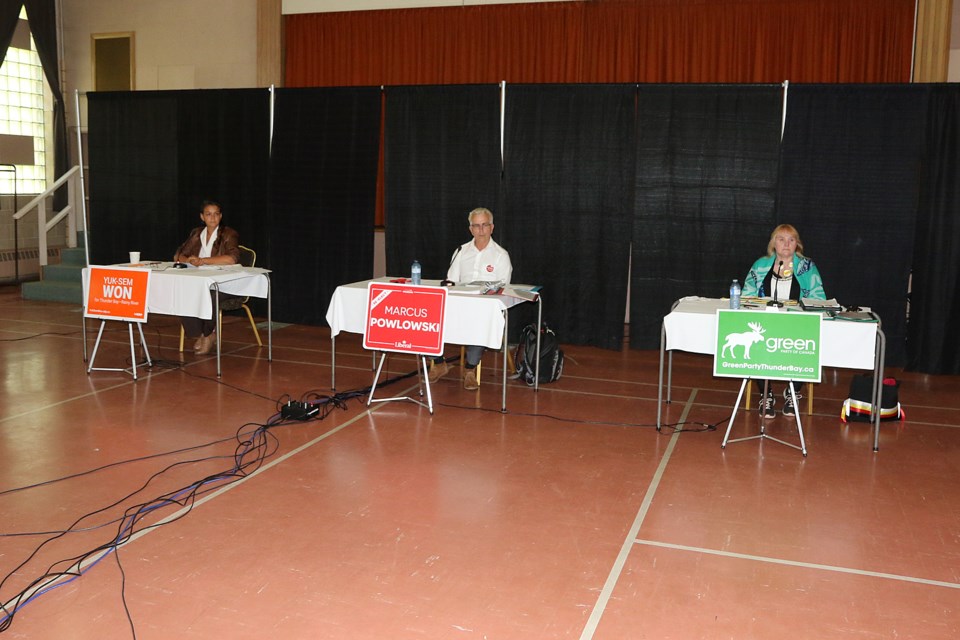
Thunder Bay-Rainy River Debate 

This past year I ran as a candidate representing the People’s Party of Canada. While I have a lot of relevant qualifications that, compared to my competition, was at minimum on par, but typically far better than my opponents I lost. I came in a distant fourth.

If it had been a “fair fight” I would tuck my tail between my legs and skulk off never to try this again. But it was not. It would be easy to complain, although, in a fashion I am, but I am going to expose the realities I faced. Realities that, while I had a sense of what I was up against, it was not until I took active part that I came to realise the many artificial roadblocks that kept me from properly giving myself the exposure that the electorate deserve.

It has become obvious to most that over the last few years there is increasing censorship in the public domain against any view that does not promote socialism. This trend I have observed from the sidelines for close to a quarter century. The event that brought this trend first to my attention was the enactment of Bill C-68, an act that required the licensing of gun owners and the registration of their firearms. Sure, I had a vested interest as I had been an avid hunter since a teenager. But when I looked at the reasons for this legislation, I could find no rational reasons that held any water. It was not as if hunters had suddenly become dangers to society.

It was, to me, the pivotal moment of “virtue signalling”; an attempt by politicians to appear they were doing something worthwhile yet under closer scrutiny there was no supporting evidence. Such signalling cannot take place without the support of the press. This was the moment I noticed that our media collectively had taken on a new role. Rather than questioning those in power, required by a true democracy, they had decided to take a side. One that was idealistic rather than rational. One that began the ever-increasing infringements of personal freedom.

This trend has been escalating to the point that we are now on the verge of dictatorship all because the media have become propagandists rather than holding those elected accountable. They have become the purveyors of “misinformation”, lies and outright censorship rather than the pursuers of truth like they used to be.

I knew this would be a major challenge when I decided to put my name forward to represent the People’s Party of Canada in the recent federal election. As a result, I had formulated a plan to try and circumvent that censorship by avoiding as much as possible the established media. This I naively thought could be easily done by bypassing the media and dealing directly with the voting public. Why was I naive? Because I did not take into consideration the challenges that I would have to face.

One challenge was just sharing with people who I am and what I was all about. In recent years one tool that became available was Facebook. But no longer. They tightly control sharing of information, especially if not of a political leaning they support, and that includes the People’s Party. For example, during the campaign I tried to let people know in out lying communities I would be in town by “boosting” a post announcing when and where I would be. Facebook denied that option saying it was “political”. And then would make sure my Facebook page was bombarded by paid advertisements for the other parties.

Another opportunity that was denied was being invited to either of the “all candidates” debates scheduled by the Chamber of Commerce and the local television broadcaster. See the picture at the top of this post. Out of the 5 candidates running only 3 were present. The two missing are myself and the Conservative candidate who declined her invitation. Why was I not there? Because on a national level the party I had chosen to represent, had too low a popularity based on biased “opinion” polling and thus the organizers felt it was inappropriate to invite me. To "an all candidates" debate. One where no one in the riding was polled to determine who should be invited. To this day I still cannot rationalise this as what has that got to do with who the local candidates are? If I had been an "independent" with no relationship to a National party would I still have been excluded? But I was not surprised.

My real problem was that the focus of my campaign was trying to get hard copy material into the hands of as many electors as possible. First, I did not appreciate the costs involved and the severe disadvantage I had in not having access to funds through fund raising. Without question the Canada Elections Act does not do any favours for newbies like me. I was up against multiple 500-pound gorillas who just, through the financial resources available to them, I just could not compete against. This compounded the fact that I had to rely on a bare bones approach which, In the end, failed to deliver. I doubt many even looked at my material.

In the end, I am very confident that when ever I had the chance to talk to people, they felt I was a credible candidate with the right qualifications, including strong morals and ethics. I just did not have the exposure I needed, much of that due to the traditional media. A “fair” fight it most certainly was not. I am not bitter, but I am disappointed coloured by sadness. We as Canadians have traditionally prided ourselves on being a truly egalitarian society to the point that we commonly mock our neighbours to the south who brag about “freedom”, “justice” and “free speech” when they have none of that. Now I know firsthand that neither do we.