Saturday, April 25, 2026

AUBUT: Why Canada’s ‘first-past-the-post’ system still works better than you think

https://www.westernstandard.news/opinion/aubut-why-canadas-first-past-the-post-system-still-works-better-than-you-think/72891

Electoral reform promises fairness, but often shifts power away from voters and into party backrooms. 

Canadian political parties on a weigh scale 

Published on: 


First-past-the-post worked in Canada for so long because it matched the country we had. It was simple. Each riding chose one member of Parliament. The candidate with the most votes won. Voters knew who represented them. They knew who to blame. They knew who to throw out. Elections Canada still describes the federal system in exactly those terms: Canadians vote for a local member, and the candidate with the most votes in the riding is elected.

That system did not promise perfection. It never did. It could produce lopsided seat counts. It could leave some voters disappointed. It could reward parties whose support was spread efficiently across ridings and punish parties whose support was spread thinly. For more than a century, Canadians lived with those trade-offs because the basic deal was clear: local voters chose a local representative, and broad national parties had to prove they could win actual constituencies, not just stack up abstract support on paper. That is one reason first-past-the-post helped produce broad brokerage parties in the first place. It pushed parties to build coalitions that could win in many ridings, not just excite narrow factions.

That is also why the modern case against first-past-the-post so often rests on appearance. Proportional systems are sold as fairer because they appear more mathematical. They appear more inclusive. They appear to make every vote “count.” At first glance, that sounds democratic. Scratch a little deeper, and the picture changes. Democracy is not only about turning votes into seat shares by national math. It is also about who chooses the representative, who holds him to account, and who gains power after the votes are cast. Under first-past-the-post, the voter in a riding chooses the member. Under many forms of proportional representation, especially list-based systems, much more power shifts to party organizations, party rankings, and post-election bargaining. The voter may feel more represented in the abstract while becoming less powerful in practice.

That is the part reform advocates often prefer to blur. They talk about “every vote counting” as though the phrase settles the matter. It does not. Every vote already counts under first-past-the-post. The question is what it counts toward. Under our current system, it counts toward choosing a local winner. Under proportional systems, it often counts toward building a party's total that is later translated into seats through a formula. Those are not the same thing. One is a direct local choice. The other is party allocation. If the public is voting for a person, first-past-the-post keeps the link clean. If the public is mainly voting for a party brand, proportional systems make more sense. But Canada’s Parliament is made up of members who are supposed to represent actual constituencies, not just serve as seat fillers for party headquarters.

That is why the push for reform was never just about democracy. It was also about power. The idea of electoral reform did not suddenly appear in the last decade. The Law Commission of Canada was already arguing for change in 2004. So the idea was there. What changed later was not the existence of the argument, but its political urgency. The issue became much louder when the existing rules stopped producing the outcomes some parties and activists wanted. That is when a long-standing academic debate became a moral cause.

The clearest example came in 2015. The Liberal platform promised that 2015 would be the last federal election held under first-past-the-post. That was the party’s own platform. The pledge was useful because it let the Liberals wrap themselves in the language of democratic renewal while presenting the existing system as tired and unfair. But once in office, and once reform threatened to produce risks of its own, the promise was abandoned. That episode told Canadians something important. The demand for reform was not a sacred principle. It was a political tool. It was useful while it served power. It was dropped when it no longer did.

That is the broader pattern. When parties win under first-past-the-post, they speak the language of mandate, stability, and clear accountability. When they lose under first-past-the-post, they start talking about fairness, distortions, and democratic renewal. The rules themselves have not changed. The only thing that changed is who benefited from them. That does not mean every reform advocate is cynical. Some are sincere. But sincerity does not erase incentives. And the incentive here is obvious. A party or faction that cannot win enough ridings under the existing rules has every reason to ask for a system that gives it more influence after the fact.

That is where the phrase “vote splitting” fits in. In Canada, it is less a neutral description than a pressure tactic. It tells voters not to choose the candidate they actually want, but the least objectionable candidate who has the best chance of blocking someone else. It is sold as realism, but it is really an attempt to herd voters back into larger party corrals. It also assumes that votes somehow belong to one of the major parties by default. They do not. In a genuine multi-party system, a vote cast for one party is not stolen from another party. It is cast where the voter chose to place it. “Vote splitting” is often just the complaint of people who resent the fact that other citizens refused to fall in line.

The defenders of proportional representation usually answer by pointing to vote-seat fairness. That is a real point, but it is not the only point. A system can be more proportional while being less direct. It can be more mathematically tidy while giving party insiders more control over who actually enters the legislature. It can give small parties more bargaining power than their raw public support would suggest. Scotland gave a good example. In 2021, the Scottish Greens entered a cooperation agreement with the minority SNP government and secured the nomination of two Green ministers. That may be entirely lawful, and it may even be stable for a time, but it shows the trade-off clearly. A small party can gain influence far beyond its seat count once the real politics moves from the ballot box to post-election negotiation. That is not obviously more democratic. It is simply a different kind of politics, one that often favours insiders, bargaining, and party management over direct local choice.

First-past-the-post, by contrast, keeps the central democratic act in the open. The public votes. The riding decides. The winner is known. The loser is known. Accountability is local and visible. That simplicity tells the voter plainly what he is doing. It also forces parties to spread their case broadly enough to win actual ridings rather than rely on after-market bargaining to convert narrow support into legislative influence. That is one reason the system held legitimacy for so long. It fit a country that still believed representation should mean more than party math.

None of this means first-past-the-post is above criticism. It is not. It can exaggerate majorities. It can punish movements whose support is scattered. It can produce governments with less than half the popular vote. But those weaknesses have to be weighed against its strengths, not against a fantasy. The alternative is not some neutral machine that magically delivers pure democracy, rule by the mob. In its rawest form, democracy means majority rule. That may sound noble, until the majority is driven by fear, anger, envy, or fashion. The American founders understood that danger and built checks into their Constitution to reduce the risk of tyranny by the majority. The French Revolution showed what can happen when that danger is ignored.

That is why proportional systems should not be sold as though they are automatically more democratic, and therefore better. They are simply a different set of trade-offs, often hidden behind nicer language. More proportional can mean less direct. More inclusive can mean more mediated. More representation can mean more power for parties, lists, and post-election deals. Democracy is not a gift from God. It is a tool, and like any tool, it can be used well or badly. The real question is not which system sounds nicer. It is the one that leaves power closest to the voter and makes it easiest to see who is responsible when things go wrong.

That brings us back to appearance. Electoral reform in Canada was often sold as though it were clearly more democratic, more modern, and more fair. But what looked fair at a distance often amounted to a shift in where power would sit. Less with the local voter. More with party structures. Less with a clear local winner. More with negotiated outcomes after the election. Less with the public choosing a representative. More with parties deciding how support gets turned into seats. Once again, the appearance was cleaner than the reality.

That is why the real question is not whether first-past-the-post is flawless. It is whether the alternatives are being sold honestly. Too often they are not. Too often, the language of democratic reform is used to hide a simpler motive: power for those who could not get enough of it under the old rules. The public is told it is being offered more democracy when, in fact, it is often being offered more party control, more bargaining, and more distance between voter and representative.

Canada does not need prettier language about democracy. It needs honesty about trade-offs. First-past-the-post worked for so long because it made one thing clear: the voter in a riding chose the member for that riding. Reform movements gained force not because the principle suddenly became unjust, but because the political class saw advantage in dressing its frustrations up as democratic virtue. That is the appearance. The reality is power.

Sunday, April 12, 2026

AUBUT: ‘Liberal,’ ‘Conservative,’ ‘NDP’ — three labels that no longer mean anything

 Canada's major parties have become costume contests. Different names, different branding, same expanding state — and voters are still falling for it.

Parliament Hill 

Published April 12, 2026


Politics in Canada has become a theatre of appearances. Parties wear names that suggest one thing while practicing another. The Liberal Party still wraps itself in the language of freedom, dignity, responsibility, and the rule of law. The Conservative Party still speaks as though it stands for restraint, continuity, prudence, and smaller government. The New Democratic Party (NDP) still tries to present itself as the voice of the average person. Yet when these labels are tested against conduct, what emerges is not a clean contest between opposing principles, but a set of rival machines operating inside the same broad government system, each asking the public to judge by appearance rather than by result.

That matters because appearance used to matter in politics. It still should. In ethics, the question is not only whether a person is ethical, but whether he appears to be ethical. Public trust depends on that distinction. A party does not have to be convicted in court before the public is justified in asking whether its conduct matches its self-description. An odd pattern in the numbers does not have to prove a crime before it becomes a legitimate reason for suspicion. Appearance is not proof, but it is often the first sign that something deserves scrutiny.

Start with the Liberals. Historically, the Liberal tradition in Canada came out of the Clear Grits in Ontario and the Rouges in Quebec. It presented itself as reform-minded, aware of rights, and more open to liberty, trade, and individual initiative than old Toryism. Over time, however, the Liberal Party of Canada became the classic broad coalition party, less a vessel for first principles than a machine for assembling coalitions across region, language, and class. It still speaks in noble language. Its own constitution says the dignity of the person and liberty under the rule of law stand at the heart of a democratic society. That is what it says. The problem is what it does.

No serious observer can pretend the modern Liberal Party has honoured that language consistently. The SNC-Lavalin affair alone was enough to destroy any automatic assumption that Liberal professions of respect for institutions and the rule of law should simply be taken at face value. The federal Ethics Commissioner found that Justin Trudeau broke the Conflict of Interest Act by trying to influence a decision on whether the case would go ahead. Nor is it the only episode to leave the public asking whether Liberal talk about law and ethics is a sincere conviction or merely branding. The point is not that every suspicion has been proven in court. The point is that the party’s conduct has repeatedly given reasonable people grounds to doubt that its public language and private behaviour still align.

Even where the law has not been directly engaged, the appearance problem remains. Section 119 of the Criminal Code makes it a serious criminal offence to corruptly offer money, office, employment, or something else of value to a member of Parliament or a provincial legislature. That matters because politics is full of offers, denials, whispers, and arrangements that may never reach the standard of proof required in a courtroom, yet still leave the public with a justified sense that lines are being blurred. A healthy political culture used to understand that appearances alone could damage trust. Today, too often, the absence of a charge is treated as though it were proof of innocence. It is nothing of the sort. It is only the absence of a charge.

The Conservatives are different, but not as different as their name suggests. Historically, Canadian conservatism was never just the politics of low taxes and a weak state. It was rooted in the old Tory concern for order, continuity, Parliament, the Crown, and the preservation of institutions. Later, it developed a Red Tory wing comfortable with using the state for national cohesion and public goods. The present Conservative Party of Canada is not even a pure heir to that older tradition. It is the product of the 2003 merger between the old Progressive Conservatives and the Canadian Alliance. In other words, it is a hybrid, part Tory, part market liberal, part Western populist, and part manager of the bureaucracy. It still talks more seriously than the Liberals about fiscal prudence, property, federalism, and limits on government. But in practice, it too has shown itself more willing to administer the existing state than to reverse its deeper direction.

That is why so many voters now look at the Liberals and Conservatives and see less a contest between different destinations than a contest over pace. One moves faster. The other moves more slowly. One pushes centralization and managerial activism more openly. The other prefers caution, trimming, and gentler language. But both have lived for decades inside the same broad political order. That is why the names themselves have become misleading. “Liberal” no longer means what a student of Locke would expect it to mean. “Conservative” no longer means what a voter seeking real restraint or rollback might hope it means. In Canadian practice, both labels often describe style and tempo more than first principles.

The NDP deserves mention here as well because it has its own appearance problem. For years, it has tried to present itself as the party of the average person. Yet its recent national convention displayed a different instinct altogether. The process was wrapped in the language of equity-seeking groups and identity-conscious rules. That in itself is bias dressed up as fairness. The very act of singling out some groups for special procedural treatment is discrimination, however politely framed. Then, after all the signalling, the party still ended by choosing another white male from the same activist class it claims to oppose. The issue is not that he is white or male. The issue is that the moral performance was just that, a performance. The branding says labour. The culture says virtue. The result says elite ideology dressed up as concern for the common worker.

All three parties, therefore, suffer from a common disease. Each claims a public identity that no longer matches its actual behaviour. The Liberals still invoke freedom while growing ever more comfortable with central management, redistribution, and moral language used to pressure people. The Conservatives still invoke restraint while too often acting as custodians of the same expanding state they claim to oppose. The NDP still invokes the working man while increasingly speaking the language of activist sorting, symbolic preference, and ideological theatre. Different costumes. Same stage.

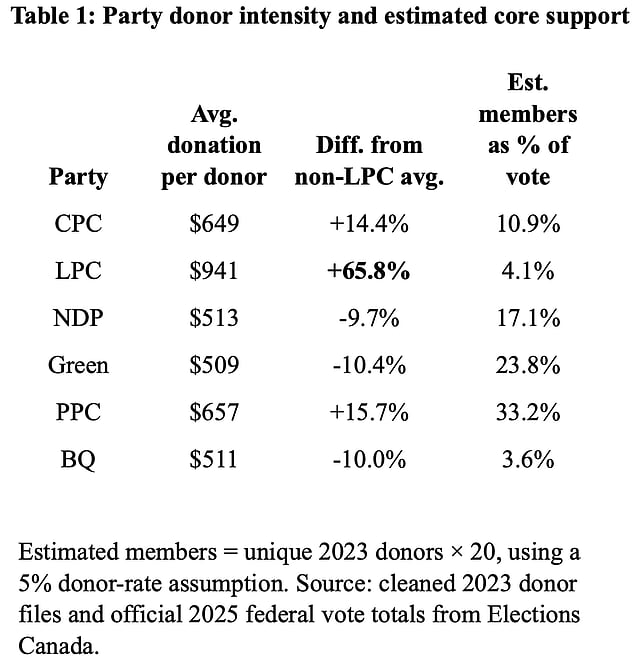
Table 1: Party donor intensity and estimated core support

This is where appearances begin to matter. The donor numbers create an appearance problem. As shown in the chart, when the 2023 donation data are grouped by unique donor and compared across parties, the Liberal Party stands out sharply. Its average donation per donor is roughly 65.8% above the average of the other five federal parties in the comparison. The Conservatives are above the pack, but not remotely in the same way. The Liberals are the clear outlier. That appearance alone is enough to raise serious questions about access, influence, and trust.

That same analysis also reveals something else. The active donor base of each party is far smaller than the total vote each party receives. In other words, most voters are not formal party members at all. They are not locked into permanent tribes. They are looser, less committed, and more available to movement than party insiders would like to admit. That fact matters because it means party branding still has immense power. A voter does not have to be a Liberal member to be swayed by the Liberal name. He does not have to be a Conservative member to be soothed by the Conservative label. That is exactly why appearance matters so much. These names are still doing work even after they have ceased to describe reality with much precision.

The real issue, then, is not whether parties can still quote their constitutions or point to noble language in their policy books. The issue is whether the public should continue accepting labels that now function more as cover than as description. In politics, as in ethics, appearance cannot be dismissed simply because proof is incomplete. When a party repeatedly behaves in ways that contradict its self-description, trust should fall. When a party’s donor profile throws off a major red flag, suspicion should rise. When a party’s rhetoric and conduct diverge long enough, the public is entitled to stop taking its name seriously.

That is where Canada now stands. We have parties whose names suggest liberty, restraint, or concern for the common man, while their conduct increasingly points elsewhere. We have a political class that still expects the public to react to branding as though branding were substance. And we have too many citizens still prepared to judge parties by what they call themselves rather than by what they actually do.

Appearances used to matter because shame still mattered. A party that looked compromised, arrogant, hypocritical, or ethically suspect paid a price. That line needs to be restored. If the names no longer fit, the public should say so. If the conduct no longer matches the branding, the public should say so. And if the appearance of legality, ethics, or democratic principle is being used to conceal something quite different, then the public should stop pretending that the gap does not matter.

The names remain. The reality has changed. That is the problem. And until Canadians are willing to judge these parties not by their labels but by their conduct, appearance will keep winning over truth.

Thursday, April 2, 2026

AUBUT: To leave or stay, that is the question

 https://www.westernstandard.news/opinion/aubut-to-leave-or-stay-that-is-the-question/72424

How Ottawa's unchecked power, bilingualism bias, and constitutional failures have pushed Alberta toward independence — or something bolder.

Stay Free Alberta revealed on Tuesday that its Alberta independence petition has surpassed the signature threshold required under Alberta’s Citizen Initiative Act. 

Published April 2, 2026 

R.T. Wells recently had an interesting, at least to me, take on independence, Alberta style. He is 100% correct that what took place in Quebec is different. Very different. In Quebec’s case, the result was not really independence so much as leverage through extortion. Transfer payments are one of the clearest examples. 

In the case of Quebec, it was never about going separate ways. It was, and still is, all about getting special privileges without earning them. Take language, for example. Every time I looked up what “culture” meant, it never included language. The two are related, yes, but they are not the same thing. Lots of countries share a common culture or civic identity without sharing a single language. Switzerland has four national languages. Belgium has three official languages. Spain has regional languages alongside Spanish. Yet each remains a distinct nation.

No, Quebec has always wanted the best that Canada had to offer without the associated costs. To do that, it has made extortion a science. I remember well when Maclean’s declared Quebec the most corrupt province in Canada. Quebec’s reputation for scandal did not come from nowhere. A couple of highlights from too long a list include the Charbonneau inquiry and the SNC-Lavalin scandal. The record speaks for itself.

So what was the result? The rest of Canada must kowtow to every Quebec demand. Want to work for the federal government? Too often, supervisory or management roles require fluency in both official languages, whether warranted or not. We have a Charter of Rights and Freedoms, as well as a Bill of Rights. Discrimination is supposedly not condoned, yet, thanks to Quebec being the main driver, it is.

You may be wondering why I bring this point forward. Sure, my last name is French in origin. My father spoke the Canadian dialect, but not at home. I am pretty adept at learning a lot of different things, but I have always struggled with language to the point that the only class I ever failed was French. For many years, I was embarrassed by that fact. Obviously, no longer, as I do not condone extortion, no matter the reasons given to try to legitimize it.

As for Alberta, I lived there for three years, and it left me with many positive memories. The beauty of the Rockies. The friendliness of the many people I met there, especially the drivers. To illustrate, soon after arriving in Edmonton to continue my education at the University of Alberta, my wife and I were standing on a street corner wondering where we should go next. We were not trying to cross, but standing back from the curb. Even so, drivers from both directions stopped to let us cross. We waved them off but appreciated the kindness given without demanding it. That was something we had not experienced back in Northwestern Ontario, where we had come from.

We bought our very first brand new automobile there, an early model Honda Civic. No sales tax to complicate the purchase. What was on the sign was what we paid. And our oldest son was born there and is now back in the province, as are several other family members. We loved Alberta then and still do.

Yet we left. Why, you may ask? Simply because the part of Northwestern Ontario where both my wife and I grew up is a place we love. We are on the north edge of Lake Superior. Lakes, rivers, and small streams abound. As does wildlife. I especially had, and still have, a passion for the outdoors. That is why I became a geologist. And where we live still provides us both with enjoyment. But at a cost.

Over the years, I have come to despise government overreach. It has pained me terribly to realize that Canada was built on a shaky foundation at best. As I described in my previous essay, The Divergent Paths of Liberty and Loyalty, I did not fully appreciate until recently how few real checks and balances Canada has against those determined to strip away rights and freedoms.

Many Canadians gripe about the Americans, but that is often jealousy, to borrow Heinlein’s phrase, “a symptom of neurotic insecurity.” I have never made it part of who I am to be insecure by refusing to acknowledge strengths and weaknesses, whether my own or those of others. I usually sit on the sidelines observing, analyzing, and processing what I see and hear. As a result, I have come to greatly admire the American Constitution and its related Bill of Rights, both designed to limit government.

Here in Canada, all we really have are limits on us. In practical terms, we do not truly own even land in the full sense people imagine. Yes, a person can hold a title. But use of that land remains subject to taxation, zoning, land-use controls, and expropriation powers. So when Canadians talk about ownership, they too often confuse possession with true control. 

For a long time, Canadians did not really have too many issues because those we elected usually at least tried to represent us, the people. But beginning, I would say, about fifty years ago, things started to change. Those in government did more and more to make themselves wealthy and place themselves above the law. At the same time, they enacted more and more legislation to take away what rights we felt were truly ours, freedom of speech and the right to protect oneself being two examples.

The American Constitution was built on one major concept: do not trust government, because in the hands of the wrong people, bad things can happen. That was based on a thorough study of history beginning with the origins of what is now called democracy. A system whereby citizens get to select who rules them by giving each person an equal vote. But a vote only has real value when the voter has skin in the game. If you have something to lose, you are more likely to pay attention and vote accordingly. If you have little or nothing at risk, then “free” becomes very appealing, especially when someone else will be forced to pay for it. That is how democracy becomes a tool for legalized plunder and, eventually, tyranny by the majority.

How do you protect yourself from that happening? By having checks and balances. In the United States, they have three primary branches of government: the executive, the legislative, and the judicial. Each is meant to keep the other two under control. Then there is another layer. The legislative branch is itself divided into two houses. One reflects popular majorities. The other gives the states, including smaller ones, a voice that can check the passions of the moment and the sheer weight of numbers. A bill must pass both houses. That is not perfect. Nothing designed by man is. But the Americans at least understood the danger and built checks on top of checks. 

As for meaningful checks on federal power in Canada, I cannot think of one. Yes, formally we have a Senate, but it is now too often a partisan rubber stamp. Legally, bills must still pass both the House of Commons and the Senate before receiving royal assent. In practice, the Senate has far too often served as cover rather than a real barrier when one was needed. 

The only true check we had was the Fifth Estate, the independent media. But that is, in essence, gone, as too much of it has allowed itself to become a bought-and-paid-for shield for whichever faction it chooses to favour.

That brings us back to Alberta, a province that is supposed to have jurisdiction over its own economy, natural resources, and education, to name three examples. Yet for far too long, the federal government has taken control where it should not. And what has there been to stop it? Nothing. 

As former US Supreme Court Justice Felix Frankfurter stated, “If one man can be allowed to determine for himself what is law, every man can. That means first chaos, then tyranny.” That is uncomfortably close to the situation we now live in, where party machinery, cabinet discipline, and a Senate that too often falls into line leave far too much power concentrated in the hands of those few we have elected. 

Over the last decade, the Charter of Rights and Freedoms has proven to be a worthless piece of paper as a restraint against a determined government. Unlike the US Constitution, it does not limit what those in power can do. Instead, Section 1 tells the story of how our rights are subject to “reasonable limits.” But who gets to decide what is reasonable? The very system seeking power.  “Reasonable” is one of those weasel words that means whatever those in authority need it to mean at the time. Thus, in Canada, those who govern decide, and not we, the people. 

So, is Alberta justified in questioning the experiment in constitutional monarchy and parliamentary democracy? I believe so. Our system has no real internal restraints and far too many excuses for expanding central power.

There are three options available: fix the government in Canada, extricate oneself from Canada to form an independent country, or join the United States of America. The first is designed never to happen. The second is fraught with its own dangers. At least the third has a constitutional framework already established, and the US remains by far our largest trading partner. 

In short, if I were living in Alberta, I think you already know what I would do.