Friday, August 1, 2025

AUBUT: Canada's one-way political conversation has to be challenged

https://www.westernstandard.news/opinion/aubut-canadas-one-way-political-conversation-has-to-be-challenged/66572 

'Once a metaphor for shifting public opinion, the Overton Window has been replaced by a mechanism of exclusion — where media, government, and cultural elites now decide which ideas may enter and which must remain forbidden.' 

AUBUT: Canada's one-way political conversation has to be challenged 

Published on: 

 The Overton Window is a political theory that describes the narrow band of ideas considered acceptable in public discourse at any given time. Originally developed by Joseph P. Overton of the Mackinac Center for Public Policy, it was designed as an analytical tool to explain why some policies gain traction while others are dismissed, regardless of their logical or moral grounding. It became a framework for understanding how ideas move from unthinkable to acceptable, and sometimes into law, by shifting what the public is willing to tolerate or support.

Overton framed his model around a "window" to capture how public perception functions: the public can see a range of ideas, but only those within the frame are considered legitimate topics for serious political or media engagement.

Ideas outside the window are either invisible or instantly discredited. This was a metaphor of perception, not necessarily of action. The window could shift left or right, widen or narrow, depending on cultural change, political momentum, or media influence. But what remained implicit in the metaphor was that the public did not move through the window; rather, the window moved to adjust what the public was shown and allowed to consider.

In theory, this model explains incremental change. Ideas can be slowly normalized. What is unthinkable becomes radical, then acceptable, then sensible, then policy. Conversely, ideas can be moved out of bounds and stigmatized. The metaphor assumes a kind of passive observer — someone watching from behind the glass, granted a curated view of the political landscape.

But the events of the past decade, and particularly in Canada leading up to and during the 2025 federal election, have exposed the limits of the Overton Window metaphor. It no longer adequately describes the active mechanisms of suppression and control being exercised by institutions such as the media, government, academia, and cultural gatekeepers. A more accurate metaphor, one that acknowledges the intentional exclusion of ideas, is the Overton Door.

Unlike a window, which simply allows or restricts view, a door must be opened or closed by someone. It implies action. Control. Agency. And most importantly, permission. Where a window is passive and observational, a door is active and restrictive.

The transition from the window model to the door model marks the shift from perception management to narrative enforcement. This is not simply about framing acceptable debate. It is about blocking it altogether. The best disinfectant is sunlight but when totally blocked, the pestilence continues to fester, unabated.

Take, for example, the public discourse surrounding Islam in Western societies. While Christianity and Judaism are routinely subjected to criticism, satire, and institutional scepticism, any critical examination of Islam’s doctrinal or cultural conflicts with liberal Western values is reflexively dismissed as Islamophobic.

The core contradictions — such as those between Islamic orthodoxy and feminist ideals, or LGBTQ+ rights — are not debated; they are avoided. The door is shut.

The subject is not just discouraged but forbidden. And it is forbidden not by public sentiment alone, but by coordinated institutional behaviour. The media refuses to engage, politicians evade and academics retreat.

In 2017, British author and political commentator Douglas Murray faced widespread backlash and de-platforming campaigns following the release of "The Strange Death of Europe," in which he questioned immigration policies and highlighted ideological clashes between Islamic doctrine and Western liberal norms.

In Canada, similar observations have rarely been allowed to surface within mainstream outlets. This is not a window adjusting public perception. This is a door being slammed to prevent public participation.

Another example is the residential school narrative in Canada, particularly the explosive claims of unmarked graves. Despite the absence of independent forensic validation, the matter has been elevated to unquestionable national truth. Any demand for verification or scientific method is dismissed not as a call for rigour, but as denialism.

British Columbia MLA Dallas Brodie came under immediate fire in 2025 for pointing out the absence of confirmed remains at the Kamloops site, even though her statement was factually correct. Similarly, lawyer James Heller faced libel attacks and professional smears simply for advocating the use of forensic standards when discussing potential grave sites.

The Overton Door metaphor reveals the mechanism here: the topic has not merely moved out of the frame — it has been locked away, and those who try to access it face public shaming or institutional censure.

Similarly, discussions around race and discrimination operate on a controlled-access model. Discrimination against white populations, or the idea that affirmative policies might disadvantage others, cannot be openly questioned. Such concerns are branded as racist before they are even engaged.

In the United States, author Heather Mac Donald has faced boycotts and protests on university campuses for her work questioning race-based hiring and policing narratives. In Canada, even raising questions about differential treatment in academic admissions or job placement is enough to be blacklisted from mainstream platforms.

Again, this is not the perception-management of a window; it is the ideological triage of a door, deciding which voices may speak and which must be silenced.

In the 2025 Canadian federal election, the consequences of this door-centric media culture were fully exposed. Public debate was corralled into a tightly managed narrative: only Liberal or Conservative choices were considered viable, despite deep dissatisfaction across the political spectrum. Core issues like immigration, inflation, housing, and civil liberties were not examined in any meaningful way by legacy media. Alternative parties or independent voices were either ignored or portrayed as threats. This was not a matter of perception. It was enforcement.

Polls were wielded not as instruments of insight, but as tools of reinforcement. Methodologically flawed, unrepresentative, and statistically weak surveys were paraded as evidence of consensus. They shaped expectations rather than recorded them. And media outlets treated these polls as gospel, offering no challenge, no critique. It was as if the door had been bolted shut on electoral diversity, and the public was told to remain still in the corridor.

Even the political philosophy underpinning Western governance has been subjected to door-like control. The traditional spectrum of Hobbesian collectivism versus Lockean individualism — once central to understanding political thought — has been eclipsed by hollow left-right binaries. In reality, the most important distinction is between those who believe in centralized authority for the sake of security (Hobbes) and those who believe in limited government to protect liberty (Locke.)

Today’s progressive ideology increasingly aligns with the Hobbesian model, cloaked in compassion but oriented toward state control. The media class — aligned with this vision — acts as gatekeeper to suppress Lockean arguments. Personal liberty, self-determination, even scepticism of power, are now traits marked as suspect. When Lockean views are expressed — calls for smaller government, individual accountability, or constitutional restraint — they are often met with labels like "far-right," "extremist," or even "Nazi," regardless of whether such terms bear any factual basis.

These accusations serve one purpose: to shut the door on the conversation before it starts. Meanwhile, Hobbesian views advocating for more state power, surveillance, and social conformity face no such linguistic policing. The asymmetry is telling. One side is granted the legitimacy of concern; the other is smeared into silence.

Mr. Trudeau’s government, and now Mark Carney’s leadership, represent this evolution. Both operate within the language of equity and social responsibility, but their real impact has been the expansion of state influence, the marginalization of dissent, and the narrowing of debate. The media has been their enabler, not their critic. It is not just that the window has shifted. The door has been shut, bolted, and guarded.

This brings us to the key distinction: the window metaphor focuses on perception; the door metaphor reveals power. A window moves to adjust what the public can see. A door is controlled by someone who decides who gets to pass — a guardian at the gate there to keep the inquisitive mind out. When institutions curate the narrative so that entire subjects become untouchable, when access to debate is granted or denied based on ideological loyalty, we are no longer in the realm of social consensus, we are in the domain of information authoritarianism.

The path back from this is unclear. But recognition is the first step. Those committed to liberty, truth, and genuine democratic dialogue must stop trying to widen the window and begin demanding the door be unlatched. We do not need permission to speak. We do not need institutional framing to think. And we should not accept curated access to ideas as the price of public engagement.

Joseph Overton gave us a useful concept. But the political reality of our time has moved beyond his frame. The window is now seen for what it really was, and is: a door. And it's time to demand it be opened.

Alan Aubut is a retired geologist, based in Nipigon.

Wednesday, December 8, 2021

Fear is not an Acceptable Option


I, for one, have been searching for an explanation as to why so many Canadians, and people in so many other countries, have gone insane. For example, Canada has long been governed under the principles that laws are meant to be honoured, including by the law makers, and that government is there to serve the people and not the other way round. Right now, that is not the case and specifically far too many Canadians have no problem with that! While I still have no clear-cut answer, it is obvious that they have fallen victim to a mass psychosis out of fear of a new virus. Yet I have no intention to also succumb to that fear, as it is not an acceptable option!

This has all come about due to the acceptance that we are being attacked by a virulent and deadly new virus. Ample evidence is available now, two years after it made its presence known, that neither is the case; it is NOT widely and easily contagious and it is NOT highly deadly, with most deaths being those who are infirm and on death’s door. The healthy have been spared. But not in the minds of the media, nor the minds of the general public.

To illustrate, I have two different friends that are afraid this virus will be the death of them. One is a heavy smoker. In both cases, when it is pointed out that the numbers do not support their fear, they brush it off, believing their fear is valid. Similarly, when the subject of vaccines come up and it is pointed out that a vaccine is defined as something that makes one immune yet none of the current batch of experimental drugs do that and therefore cannot be called that, they disagree without rational reasons.

The same goes for everything associated with the “controls” put in place to “combat” this “deadly pathogen.” After a year, to year and a half, has “social distancing” had a measurable positive effect? No. Has the imposition of masks had a measurable positive effect? No. Have lock downs helped, an exaggerated form of quarantine that was designed for the sick and not the healthy? No. How about those experimental drugs? No. Passports? No. None have had any positive effect on diminishing, never mind eliminating, the virus. But all have been used to destroy our rights and freedoms and the fearful masses don’t care! They are even reveling in it, welcoming with open arms the insanity that engulfed the German people in the 1930’s that culminated in one of the greatest tragedies of the 20th century, the Holocaust.

One psychologist, Dr. Mathias Desmet, a professor at Ghent University in Belgium, has a plausible explanation to describe what is happening. He calls it “mass formation,” a form of mass psychosis. Unfortunately, I don’t buy his reasons. While the diagnosis makes sense the attributed causes do not. Primarily he believes there must be widespread social isolation and disconnectedness. That does not hold up under even the lowest magnification of scrutiny. For as long as I can remember, many of us, especially me, were quite content to stay in a small bubble of social isolation. At the core though was appreciation for freedom. To say that suddenly this is no longer the case? No, it must be something else.

One change I have seen, and which correlates with observations from studying history, is the almost total absence of a social conscience; a guide to help the masses distinguish between good and evil. At one time that was through religion. It was by joining with others to review rules to help guide them as recorded in holy scripture that society was able to find a way to live peacefully with respect for the rights of others as well as for oneself. With the invention of the printing press came the “Fourth Estate,” the “media.” They took on the role of identifying good from evil, to a large part supplanting the other estates, including the Clergy (religion).

Should this come as a surprise? During my lifetime, religion has lost a lot of its control over much of society. While I am not religious, I still hold in high regard the same moral and ethical values of my friends, many of whom are religious. Few of us have succumbed to this mass psychosis. So, it is not because of feeling isolated. The only explanation that makes sense to me is a disconnect from having strong moral and ethical values that allow one to see the evil that comes with abandoning law and trying to be the master when in fact you are the servant. Our media have picked a side, and it is the side of  evil. No wonder so many act like slaves to those who wield power.

If indeed that is the case, what is the solution? How can we help those hypnotised by the evil of oppressing others under the guise of protecting yourself from an imaginary harm? I wish it would be as simple as snapping one’s fingers, Like Thanos in the movie Avengers: Infinity War, and seeing this quickly evolving dystopian world return to normal. One sure fire way of getting back to sanity, due to its widespread network, is if the Fourth Estate cast aside being propagandists, but I am not optimistic that would happen. Far too many are controlled by media barons so consumed with greed that suppression of competition and dissent have become paramount. Yet, there is hope and I am clinging to that fervently. Because the opposite, fear, is NOT an acceptable option!

Thursday, November 18, 2021

How to Lose an Election

Thunder Bay-Rainy River Debate 

This past year I ran as a candidate representing the People’s Party of Canada. While I have a lot of relevant qualifications that, compared to my competition, was at minimum on par, but typically far better than my opponents I lost. I came in a distant fourth.

If it had been a “fair fight” I would tuck my tail between my legs and skulk off never to try this again. But it was not. It would be easy to complain, although, in a fashion I am, but I am going to expose the realities I faced. Realities that, while I had a sense of what I was up against, it was not until I took active part that I came to realise the many artificial roadblocks that kept me from properly giving myself the exposure that the electorate deserve.

It has become obvious to most that over the last few years there is increasing censorship in the public domain against any view that does not promote socialism. This trend I have observed from the sidelines for close to a quarter century. The event that brought this trend first to my attention was the enactment of Bill C-68, an act that required the licensing of gun owners and the registration of their firearms. Sure, I had a vested interest as I had been an avid hunter since a teenager. But when I looked at the reasons for this legislation, I could find no rational reasons that held any water. It was not as if hunters had suddenly become dangers to society.

It was, to me, the pivotal moment of “virtue signalling”; an attempt by politicians to appear they were doing something worthwhile yet under closer scrutiny there was no supporting evidence. Such signalling cannot take place without the support of the press. This was the moment I noticed that our media collectively had taken on a new role. Rather than questioning those in power, required by a true democracy, they had decided to take a side. One that was idealistic rather than rational. One that began the ever-increasing infringements of personal freedom.

This trend has been escalating to the point that we are now on the verge of dictatorship all because the media have become propagandists rather than holding those elected accountable. They have become the purveyors of “misinformation”, lies and outright censorship rather than the pursuers of truth like they used to be.

I knew this would be a major challenge when I decided to put my name forward to represent the People’s Party of Canada in the recent federal election. As a result, I had formulated a plan to try and circumvent that censorship by avoiding as much as possible the established media. This I naively thought could be easily done by bypassing the media and dealing directly with the voting public. Why was I naive? Because I did not take into consideration the challenges that I would have to face.

One challenge was just sharing with people who I am and what I was all about. In recent years one tool that became available was Facebook. But no longer. They tightly control sharing of information, especially if not of a political leaning they support, and that includes the People’s Party. For example, during the campaign I tried to let people know in out lying communities I would be in town by “boosting” a post announcing when and where I would be. Facebook denied that option saying it was “political”. And then would make sure my Facebook page was bombarded by paid advertisements for the other parties.

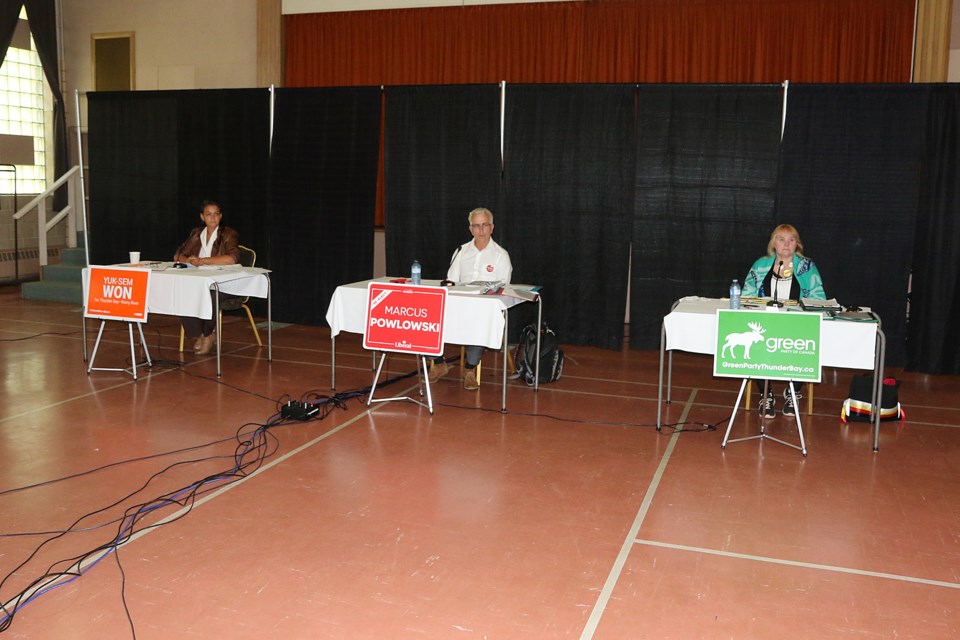
Another opportunity that was denied was being invited to either of the “all candidates” debates scheduled by the Chamber of Commerce and the local television broadcaster. See the picture at the top of this post. Out of the 5 candidates running only 3 were present. The two missing are myself and the Conservative candidate who declined her invitation. Why was I not there? Because on a national level the party I had chosen to represent, had too low a popularity based on biased “opinion” polling and thus the organizers felt it was inappropriate to invite me. To "an all candidates" debate. One where no one in the riding was polled to determine who should be invited. To this day I still cannot rationalise this as what has that got to do with who the local candidates are? If I had been an "independent" with no relationship to a National party would I still have been excluded? But I was not surprised.

My real problem was that the focus of my campaign was trying to get hard copy material into the hands of as many electors as possible. First, I did not appreciate the costs involved and the severe disadvantage I had in not having access to funds through fund raising. Without question the Canada Elections Act does not do any favours for newbies like me. I was up against multiple 500-pound gorillas who just, through the financial resources available to them, I just could not compete against. This compounded the fact that I had to rely on a bare bones approach which, In the end, failed to deliver. I doubt many even looked at my material.

In the end, I am very confident that when ever I had the chance to talk to people, they felt I was a credible candidate with the right qualifications, including strong morals and ethics. I just did not have the exposure I needed, much of that due to the traditional media. A “fair” fight it most certainly was not. I am not bitter, but I am disappointed coloured by sadness. We as Canadians have traditionally prided ourselves on being a truly egalitarian society to the point that we commonly mock our neighbours to the south who brag about “freedom”, “justice” and “free speech” when they have none of that. Now I know firsthand that neither do we.

Wednesday, November 17, 2021

Why I became a Candidate


I have been asked a few times “why did you decide to run as a candidate” in the just past Federal election. In short, for two reasons: I wanted to provide the constituents in the riding I was running to represent a real, qualified option, and the other is that when unhappy with a situation one has a moral and ethical duty to “put up or shut up”.

At its very core the electoral system in Canada is one where you vote for a person to represent you in parliament. As such the choice should be to select from the available choices the person who is best for the job. By “best” I mean someone with the appropriate skill set that they can properly evaluate the many, at times complex issues, that a parliamentarian will have to address. And one who shares morals and ethics that resonate with your own. Or at least theoretically that is how it is supposed to work.

The reality is that it instead is a “popularity” contest where qualifications seem to have little to do with the process. Far too often there is a strong disconnect in that the “candidate” far too often is a cardboard cut-out who is an avatar for a political party, specifically the personality who is the “leader” of that party. So, many of us do not vote for a representative but instead for a place holder for a person who has no vested interest in your well being.

I have a problem in that I hold my principles dearly. Too dearly in comparison to many others. I firmly believe that the person should be the primary point of evaluation when choosing who to vote for. And that the party they represent should come second. Every party has a basic platform which summarises the morals, ethics and principles that the party says they wish to promote and defend. That platform is meaningless if the representative is unable to advocate the regional wants and needs of their riding. It is for that reason that the person needs to be the primary concern.

It may appear that I have let my ego lead, but I assure you that is not the case. I do not search for the limelight and typically am most at home in the background, helping others. Because I have strong principles, if I believe something is worth supporting, I will step forward when no one else is willing to do so. My first “leadership” role was back in university where I was President of the Geology Club. Why? Because I believed in the purpose of having the club and no one else was willing to lead. So, I stepped forward. And that I have done numerous times since, whether it was being a minor hockey coach, President of the local curling club or President of a local service club. It was never about me but the belief that it was a worthy cause, and someone had to do it.

Yes, I went to university. But I have never felt that put me above others in that it made me “more educated”. The reason I went to university was an offshoot of a passion of mine growing up; I loved tramping through the bush and just surrounding myself with the natural world. When evaluating potential job opportunities at the time, being a geologist came to the forefront. And to become a geologist one had to go to university, in effect the appropriate “trade school”. It is for that reason I respect anyone who went on after high school to any form of advanced learning. We all share the same desire in that we needed to get specialised training for the trade we wished to make a career from. It doesn’t matter if that was a college, an apprenticeship program or a university. Different paths for the same basic purpose; acquiring the skills and knowledge required to do your chosen profession well.

Even so, it has opened for me opportunities and additional training that has broadened my resume and in doing so has made me quite qualified to be a representative in Parliament. While not a great public speaker I am not afraid to stand up before others and speak publicly. Being in a career that requires a lot of troubleshooting ability I am not afraid to come up with ideas that may work. Yet not offended when someone else comes up with something better. A key to be a successful geologist is being a good observer and fitting the pieces together to try and solve a puzzle. Or observing how others do a task so that, in a pinch, you can complete a similar task if needed to get the job done. To be flexible. To be willing and able to cooperate with others yet still true to oneself and to the available facts. To push back by asking questions, to ensure that the correct path is taken.

Watching what has happened these past two years have opened my eyes in that we as Canadians have created a situation we should never have put ourselves in. All because we elected people who have no qualifications to evaluate the complexities that have bubbled to the surface. We have, due to making poor political choices, had past governments who have contributed to our current problems by appointing unelected ideologues in too many key bureaucratic positions based on their politics rather than their actual abilities. How else can we explain having people with medical training who had to take an oath to “do no harm” yet come out with “recommendations” that do not follow that ethical requirement. In fact, they do not even respect our existing laws, especially our Charter of Rights and Freedoms. And where have been our “elected” representatives who are supposed to be the ones who direct the bureaucracy? No where to be found, or if they do say something, it is to show their abject ignorance of the subject at hand. To say, “we are following the science”, which is nonsense because science is a process and not a result. A process of asking questions. Of pushing back.

I am a scientist. I am a person who does know how to ask questions and do so all the time. Not because I know I am right or think I am, but because that is what science is all about. In addition, I have been an advocate for others. I am willing, and able, to stand up and say something. I may not be the most eloquent speaker, but I do know that I can see where things are leading typically before many others do. Yet no one else has made themselves available that has the skill set I have to offer. Thus, I put my name forward as a candidate.

In the end, I lost. I came in a distant fourth. It was not because I was an inferior candidate. But that is a different story that I will write about in the future.